1. Introduction
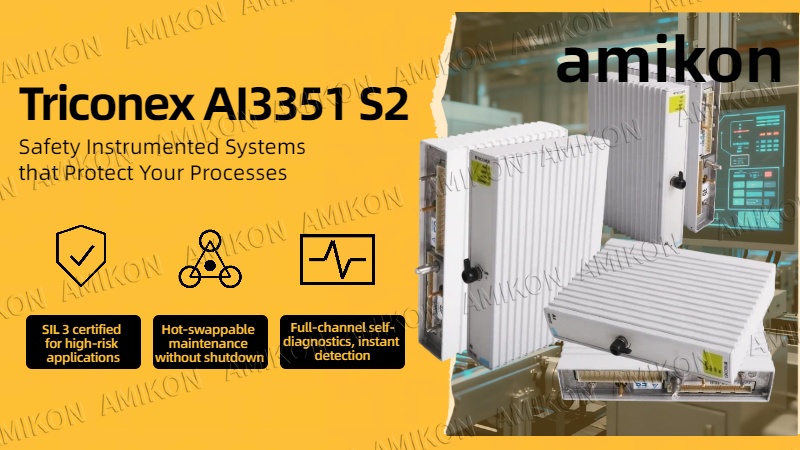
In modern high-risk process industries, such as oil and gas extraction, refining and chemical processing, nuclear power, and large-scale emergency shutdown (ESD) systems, ensuring the safe and continuous operation of equipment is crucial. Even minor control errors or instrument malfunctions can trigger catastrophic safety accidents. Triconex, a global leader in functional safety, offers the Triconex AI3351 S2 Analog Input Module, a core hardware component designed specifically for safety instrumented systems (SIS) with stringent requirements for high reliability and availability.
As a key component in a triple modular redundancy (TMR) architecture, the AI3351 S2 can acquire 4-20 mA analog signals from field transmitters with extremely high accuracy and filters transient noise and single-point hardware failures through a sophisticated internal voting mechanism, ensuring the system remains rock-solid even in complex industrial environments. This article will provide an in-depth analysis of the module's technical parameters, application scenarios, core advantages, and key points for installation and maintenance, offering professional reference for factory engineers and overseas buyers.
2. Technical Specifications
The Triconex AI3351 S2 module adheres to extremely high industrial-grade standards in its hardware design. The following are the core technical parameters and performance indicators of this module:
Product Model: Triconex AI3351 S2 (Model 3351 Analog Input Module)
Number of Input Channels: 32 Points, Commoned
Nominal Input Current: 4 - 20 mA DC
Operational Current Range: 2 - 22 mA DC (Supports 6% Full-Scale Overload)
Input Bandwidth: 16 Hz (-3dB)
Input Impedance: Internal sampling resistor 100Ω ± 0.01%, total input impedance with socket approximately 250Ω
Resolution: 12-bit analog-to-digital conversion
Absolute Error: Better than 0.15% of full scale (20 mA)
Matching Socket and Terminals: Model Model 2351 (direct wiring dock) or Model 2352 (external terminal block dock, supports 9764-310 RTD/TC/AI signal conditioning board)
Online self-diagnosis: Built-in Force-to-Value Diagnostic (FVD), full channel scan time less than 1 ms
3. Application Fields
Thanks to its unparalleled fault tolerance and SIL 3 functional safety certification, the Triconex AI3351 S2 is widely used in critical process industries with extremely high requirements for safety and continuous operation:
Oil & Gas: Pressure, temperature, and flow monitoring and emergency shutdown of offshore drilling platforms and oil and gas pipelines.
Refining & Petrochemical: Critical parameter acquisition in high-temperature, high-pressure, flammable, and explosive areas such as cracking furnaces, hydrogenation units, and catalytic reforming.
Nuclear & Power Generation: Reactor protection systems, turbine overspeed protection, and boiler combustion safety monitoring systems (BMS).
Emergency Shutdown (ESD) and Fire & Gas (F&G) Systems: As a core analog input front-end, it accurately captures minute changes in process variables on-site, preventing catastrophic accidents.
4. Core Advantages
Compared to traditional general-purpose PLC analog input modules, the Triconex AI3351 S2 boasts an overwhelming advantage in its safety architecture:
Triple Modular Redundancy (TMR) Architecture: The module contains three completely isolated independent channels (Channel A, B, C). Each channel asynchronously acquires field signals and converts them independently. Mid-Value Selection is performed via the TriBus high-speed bus between the main processors (MPs), completely eliminating malfunctions or failures caused by single-point failures.
Superior Interference Immunity and High Reliability: Employing opto-isolation and precise hardware filtering design, it complies with IEC 61000-4 series electromagnetic compatibility standards, enabling stable operation in industrial environments with strong electromagnetic interference.
Support for Online Hot Sparing and Hot-Swapping: Allows for direct online replacement of faulty modules while the system is powered on and the process is uninterrupted, significantly improving the system's mean time between failures (MTBF) and availability.
Lifetime calibration-free design: The module has high factory precision and minimal long-term drift, and no manual periodic calibration is required during its normal life cycle, which greatly reduces maintenance costs.
5. Installation & Optimization
To ensure the long-term stable operation of the Triconex AI3351 S2 in the field, engineers should follow these guidelines during installation and routine maintenance:
Installation and Wiring Recommendations
Cabinet and Grounding: The module must be installed in a compliant metal cabinet and properly grounded with protective earth to meet the stringent electromagnetic radiation standards for CE certification.
Shielded Cables: Field 4-20 mA transmitter signal lines must use high-quality twisted-pair shielded cables. The shielding layer should be reliably grounded at one end at the control cabinet. Multiple grounding points are strictly prohibited to prevent ground loops.
Power Requirements: The logic power supply and field transmitter power supply should use a certified safety extra-low voltage (SELV) DC power supply (rated 24 V DC), ensuring ripple is within permissible limits.
Power-on Testing and Maintenance: Before powering on, carefully check the physical jumpers and terminal connections of the Model 2351 or 2352 base. Use the TriStation 1131 programming software to check the module's self-diagnostic status register. If the FAULT indicator light on the panel is lit, the software can quickly locate the fault point in the specific channel for precise maintenance.
6. Conclusion
The Triconex AI3351 S2 analog input module is not merely a simple signal acquisition hardware device, but a cornerstone of the entire industrial automation control system's safety defenses. Its robust TMR architecture, stringent SIL 3 safety certification, and superior anti-interference capabilities make it a trusted choice for protecting core assets and personnel in the global process industry. For companies pursuing ultimate safety and continuous production, investing in Triconex modules is a wise move to ensure long-term, stable operation.
7. Frequently Asked Questions (FAQ)
Q1: Does the AI3351 S2 module support in-line hot-swap?
A: Yes. When the system is configured with redundant hot-spare modules, you can directly unplug the faulty module and insert the new module without interrupting the control process or disconnecting external wiring in the field; the system will automatically complete a seamless switchover.
Q2: How to quickly troubleshoot when a channel fault or abnormal reading occurs in the module field?
A: First, observe the status of the PASS, FAULT, and ACTIVE LEDs on the module panel. Then, read the system log through the TriStation 1131 diagnostic panel to check whether the problem is an open/short circuit in the field transmitter, a power supply abnormality, or an internal channel fault, and take targeted measures accordingly.
Q3: Regarding firmware/software compatibility, what are the Triconex AI3351 S2's requirements for the Tricon system version?
A: As part of the Tricon Triple Modular Redundancy (TMR) safety system, the Triconex AI3351 S2 requires a specific main processor version and TriStation configuration software. Before upgrading or replacing this module, engineers must verify the hardware configuration file in the TriStation software to ensure that the firmware version correctly recognizes its 32-channel mapping and diagnostic parameters.
Q4: How can third-party systems (such as DCS or SCADA) integrate data with the Triconex AI3351 S2?
A: Third-party systems cannot directly read the Triconex AI3351 S2 independently via the bus. Instead, they must securely transmit the 32-channel analog data acquired by the Triconex AI3351 S2 to the upper-level control or monitoring system via the communication module (such as TCM) of the Tricon main processor, through Modbus TCP, OPC, or secure communication protocols.
Q5: What are the key safety certifications and industry standards that the Triconex AI3351 S2 possesses?
A: As a key component of high-risk industrial safety instrumented systems (SIS), the Triconex AI3351 S2 meets the SIL 3 safety level certification requirements of IEC 61508. It is widely used in industries with extremely stringent functional safety requirements, such as petrochemicals, oil and gas extraction, and refining, and can effectively perform analog input monitoring for emergency shutdown (ESD) systems or fire and gas (F&G) systems.
Contact Us
Manager: Jim Pei
Email: sales6@amikon.cn
Whatsapp: +8618020776782
|
YOKOGAWA EB511-50 |
GJR2393100R1200 |
1756-IB16 |
|
YOKOGAWA ADCV01 |
88FT05C-E |
6ES7180-0AA00-0XA0 |
|
YOKOGAWA KS1 |
83SR04D-B |
1752-L24BBB |
|
YOKOGAWA YCB121 |
GJR2390200R1210 |
1734-OB8S |
|
YOKOGAWA MRI114 |
6ES7235-0KD22-0XA0 |
TK-FTEB01 |
|
YOKOGAWA MRI124 |
IMFEC12 |
IC698CMX016-ED |
|
YOKOGAWA MRI214 |
GJR2332300R0100 |
1769-BOOLEAN |
|
YOKOGAWA MRI224 |
88FV01F |
2080-SERIALISOL |
|
YOKOGAWA T9070CB |
CT-ARS-21S |
1761-ENT-ENI |
|
YOKOGAWA KS2 |
1SVR730120R3300 |
1747-ASB |
|
YOKOGAWA AKB335-M |
GJR2368900R2340 |
1794-PS3 |
|
YOKOGAWA AKB161 |
87TSO1I-E |
1794-ACNR15 |
|
YOKOGAWA AKB162 |
GJR2393200R1210 |
1769-OF2 |
|
YOKOGAWA GRVACA-677FA |
88TK05C-E |
1746-NIO4I |
|
YOKOGAWA AKB337-M015 |
HESG447419R0001 |
1747-L541 |
|
YOKOGAWA YCB301-C100 |
70EA05a-E |
1756-OA16I |
|
YOKOGAWA YCB141-M020 |
GJR2392700R1210 |
1769-IQ16F |
|
YOKOGAWA A1330EF |
83SR07A-E |
1794-OE12 |
|
YOKOGAWA A1331EF |
UNX233-8 |
1746-NR4 |
|
YOKOGAWA A1332EF |
HESG447005R2 |
1756-ENBT |
Supplyed
525011

parts to
23253

customers in
148

countries



Disclaimer:
Amikon sells new and surplus products and develops channels for purchasing such products. This website has not been approved or recognized by any of the listed manufacturers or trademarks.
Amikon is not an authorized distributor, dealer, or representative of the products displayed on this website. All product names, trademarks, brands, and logos used on this website are the property of their respective owners. The description, explanation, or sale of products with these names, trademarks, brands, and logos is for identification purposes only and is not intended to indicate any association with or authorization from any rights holder.
Powered by amikonplc.com