Control valve actuator fault: Check and repair guide
Control valve actuators are critical in industrial automation systems, responsible for converting control signals into physical movements of valves, thereby regulating fluid flow, pressure, or temperature. However, long-term operation or environmental factors lead to actuator failure, affecting the stability of the entire control system. This article will provide you with a practical check and repair guide to help quickly identify and address issues.
I. Common Types of Control Valve Actuator Failures
Before repairing, it is crucial to understand the common types of failures. Generally, actuator failures can be categorized follows:
Sluggish or Unresponsive Action
Cause: Insufficient power supply, motor damage, insufficient air source pressure (pneumatic actuators).
Symptoms: Delayed valve opening and closing, unstable response.
Valve Position Drift or Inability to Hold
Cause: Failure of actuator springs, valve sticking, gear wear.
Symptoms: Correct control signal, but the valve cannot remain stable at the designated position.
Leakage or Abnormal Noises
Cause: Aging of pneumatic actuator seals, insufficient lubrication of electric actuator gearboxes.
Symptoms: Hissing sound from pneumatic actu, abnormal noise or vibration from electric actuators.
Abnormal Control Signals or Feedback Errors
Cause: Faulty position feedback sensors, poor electrical.
Symptoms: Inconsistent valve position display on the control system with the actual position, affecting closed-loop control.
II. Fault Checking Steps
Before proceeding with repairs, follow these steps to check systematically and quickly locate the source of the problem:
1. Appearance and Connection Check
Check if the power cord air tube, and terminal connectors are loose or damaged.
Check if the actuator is securely installed and if the valve stem is stuck or obstructed by foreign objects.
2. Functional Test
Electric actuator: Manually rotate the handwheel to see if the valve can move freely.
Pneumatic actuator: Dis the control air source and check the spring return function.
Record the valve response time and actual position to determine if there are any delays or drifts.
3. Signal and feedback check
Use a multimeter or pressure gauge to measure the control signal input and feedback output.
Check if the display on the control system matches the actual position.
For pneumatic actuators, you can use a pressure gauge to check if the air source pressure meets the rated value.
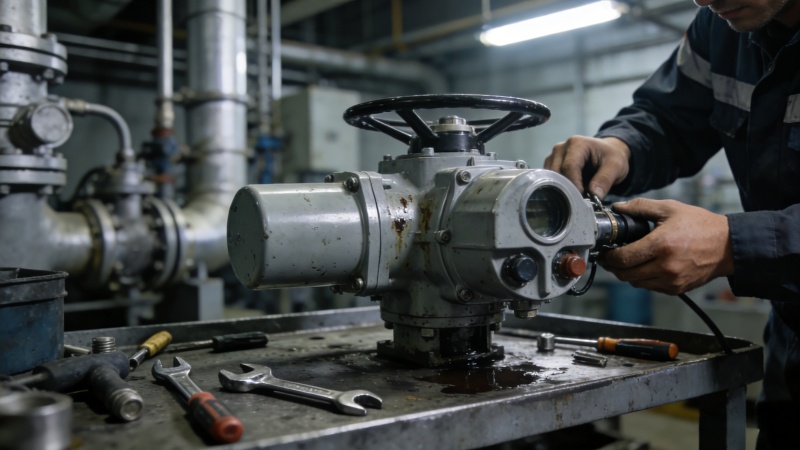
III. Repair and Maintenanceuggestions
Based on the inspection results, take the following repair and maintenance measures:
Cleaning and Lubrication
Clean the valve stem and internal dust,, and grime of the actuator, and add lubricant as per the manufacturer's requirements.
Replace Worn-out Components
Electric actuator, motor brushes, seals, or pneumatic actuator diaphragms, springs, etc., all need to be replaced regularly.
Adjust Control Parameters
Just the PID or travel limiters according to the valve travel and response time to ensure closed-loop control accuracy.
Regular Testing and Calibration
Per functional tests and position calibrations every quarter or half a year, especially for critical safety or high-load control valves.
Maintenance Log
Record maintenance, replacement of, and calibration to help with subsequent fault analysis and prevention.
IV. Preventive Measures
Maintain a clean environment around actuators and valves to prevent dust, moisture, and corrosive gases
Regularly inspect the air source pressure, power supply voltage, and the stability of feedback signals.
For critical control valves, redundant actuators or manual bypass can be configured to reduce the impact of failures on production.
Summary
The stable operation of control valve actuators directly affects the safety and efficiency of industrial automation. Through systematic inspections, functional tests, prompt maintenance, and regular upkeep, the risk of failure can be minimized and the lifespan of equipment can be extended. For industrial enterprises, a comprehensive actuator maintenance procedure not only improves equipment reliability but also reduces production downtime losses.