Modern CNC machine tools depend on a servo system that can translate nanometre-scale commands into stable, repeatable axis motion. When a servo amplifier fails, the result is rarely a minor inconvenience: the machine may lose axis readiness, stop mid-cycle, or remain out of production while maintenance teams search for a compatible replacement.
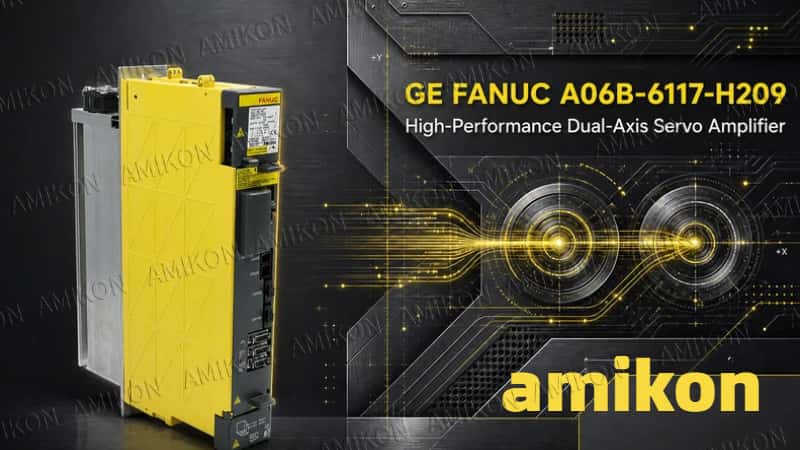
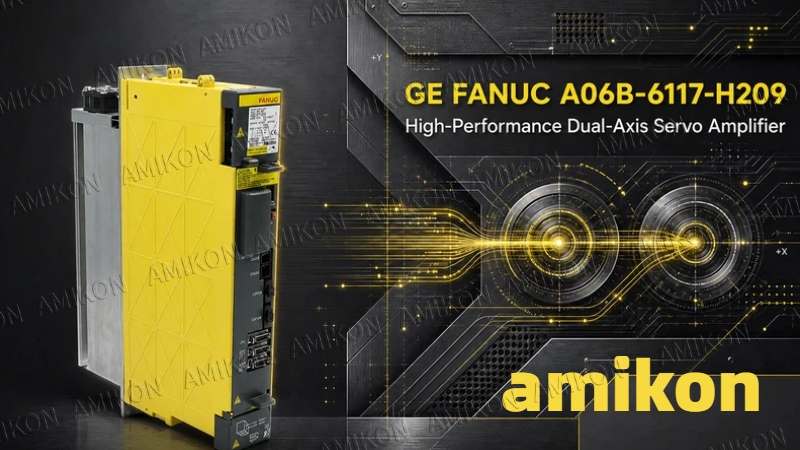
The GE FANUC A06B-6117-H209, also designated FANUC αiSV 80/80, is a two-axis servo amplifier module for the 200 V-class αi drive system. It combines two servo channels in one module and communicates with the CNC through FANUC Serial Servo Bus (FSSB). For plants maintaining established FANUC-controlled equipment, obtaining the correct H209 configuration can be the difference between a controlled repair window and extended downtime.
Key Technical Features of the A06B-6117-H209
Specification snapshot
FANUC order specification: A06B-6117-H209
Amplifier model: αiSV 80/80
Architecture: two-axis servo amplifier, L axis and M axis
System class: 200 V input-series drive system
CNC interface: FSSB optical interface
Rated output current: 19 Arms per axis
Nominal current limit: 80 Apeak per axis; the standard peak value can vary by approximately ±10% with circuit constants
Servo control support: HRV2 and HRV3
Main-circuit control: sine-wave PWM control using an IGBT bridge
These figures matter because “80/80” is a FANUC amplifier designation, not an invitation to match by motor kilowatts alone. The αiSV module must be selected for the connected servo motors. Motor model, current requirement, acceleration profile, duty cycle and paired power-supply capacity must all be considered.
Dual-axis control in a compact module
The H209 drives two axes from one amplifier. Separate CZ2L/CZ2M motor-power connections and ENC1/JF1 and ENC2/JF2 Pulsecoder inputs serve the L and M axes. This architecture reduces cabinet space and cabling compared with two independent amplifiers, while preserving axis-specific feedback and diagnostics.
High-response digital servo performance
The module supports FANUC SERVO HRV2 and HRV3 control. SERVO HRV is a digital current-control method designed for higher speed, precision and acceleration. It combines high-speed digital signal processing, high-precision amplifiers and detectors, and filters for suppressing low-frequency machine vibration. HRV2 uses a 125 μs current loop, while HRV3 uses a 62.5 μs current loop. The standard H209 is not the later “L” version intended for HRV4.
FANUC also pairs its servo systems with high-resolution feedback devices. On the H209, the two dedicated Pulsecoder channels and the fast FSSB link form the hardware path for precise closed-loop control. Encoder type, motor specification and servo parameters must still match the machine configuration.
Protection and thermal monitoring
The amplifier provides status and alarm diagnostics rather than failing silently. Relevant fault indications include inverter overheat, radiator cooling-fan stop, DC-link current, IPM overheat, undervoltage and inter-amplifier communication alarms. Software thermal overload monitoring also helps identify excessive motor current caused by vibration, incorrect power-lead connections or unsuitable servo parameters.
Target Applications
The A06B-6117-H209 belongs to FANUC’s CNC servo architecture. Typical installed applications include:
- High-speed and high-precision machining centres
- Multi-axis lathes and turn-mill machines
- Transfer machines and CNC production cells
- Gear-cutting and other specialised machine tools
- CNC-controlled positioning axes in automated manufacturing equipment
It should not be assumed to be a replacement amplifier for a FANUC industrial robot controller. Robot and CNC drive architectures are not interchangeable merely because both carry the FANUC name. Always qualify the actual controller, motor and amplifier chain.
Compatibility and System Integration
Applicable CNC families include 16i-B, 18i-B, 21i-B, 0i-B/C/D, and 30i/31i/32i. Within the Series 30i/31i/32i-MODEL A architecture, the A06B-6117-H209 is identified as the SVM2-80/80i. This establishes product-family compatibility; it does not mean every machine in those families accepts the module without verification.
Before ordering, compare all of the following:
- Full amplifier order code, including any suffix or option designation
- CNC series and model generation—not only “30i” or “31i”
- Existing amplifier nameplate, hardware revision and connector arrangement
- L/M motor order numbers, rated currents and Pulsecoder types
- FSSB topology and optical connectors COP10A/COP10B
- αi power-supply module, DC-link arrangement and total system capacity
- HRV mode, servo software and parameter backup
- Machine-builder ladder, safety configuration and commissioning requirements
For a like-for-like emergency replacement, capture the old module’s nameplate and every connector before removal. Do not substitute A06B-6127-H209: that part is the 400 V-class αiSV 80/80HV, not the 200 V-class H209 discussed here.
Installation and maintenance essentials
- Use lockout/tagout and qualified personnel. The DC link contains a large capacitor that remains charged after input power is removed. Follow the discharge time on the faceplate, confirm the red charge LED is off and verify residual voltage before touching connections.
- Use normal ESD controls when handling electronic assemblies: grounded workstation, suitable wrist strap and anti-static packaging.
- Install the amplifier in a sealed power-magnetics cabinet. Required operating conditions include an ambient temperature of 0–55°C, relative humidity of 90% or less without condensation, and vibration below 0.5 G.
- Keep coolant, oil mist, conductive dust and chips away from the electronics, heat sink and fans. In severe machine-tool environments, the electronic section generally requires an IP54-class cabinet.
- Preserve airflow and service clearance. The αiSV 80/80 uses both internal and external fans; blocked heat sinks or stopped fans can lead directly to temperature alarms and shortened component life.
- Record the CNC alarm number and the amplifier’s seven-segment STATUS character before power cycling. Those two data points are far more useful than the statement “the drive is dead.”
Minimise Downtime with the Right H209 Replacement
AMIKON provides stock-backed sourcing, documented inspection and testing, expedited worldwide shipping, and technical matching support for legacy industrial automation parts. Send us the amplifier nameplate, CNC model, motor numbers, alarm history and required delivery destination. Our team will confirm condition, compatibility checkpoints, warranty and the fastest available dispatch option.
Request your dedicated RFQ for GE FANUC A06B-6117-H209 today, or contact AMIKON technical support before ordering if the existing configuration is uncertain. A few minutes spent validating the complete servo chain can prevent days of avoidable downtime.
FAQ:
Q1: How can I determine whether the A06B-6117-H209 is failing or needs replacement?
Start with the CNC alarm and the amplifier STATUS display. An unlit display can indicate missing control power, a cable fault or a defective control-power circuit. A blinking display can indicate a shorted control supply or cable failure, while an alarm character identifies the alarm type. Common relevant indications include overheat, fan stop, DC-link undervoltage/current, IPM alarms and communication errors. Check power, FSSB cables, motor leads, feedback cables, cabinet temperature and fans before condemning the module. Replace or repair the amplifier only after external causes and incorrect parameters have been excluded.
Q2: What is the difference between brand-new, surplus and refurbished H209 units, and which should I choose?
Brand-new stock offers the clearest unused condition but may be scarce. Surplus stock can also be unused, although storage age and dormant components must be evaluated. A properly refurbished unit can be the fastest economical option when it includes traceable repair work, functional or load testing and a meaningful warranty. For critical production, choose the condition that meets the required lead time and risk level—not simply the lowest price.
Q3: What compatibility checks are required before buying this dual-axis servo amplifier?
Verify the complete order code, 200 V-class αi drive architecture, FSSB interface, 19 Arms-per-axis requirement, both motor and Pulsecoder types, αi power-supply capacity, HRV2/HRV3 control mode, CNC generation, servo software and saved parameters. Also compare the physical connector layout and machine-builder configuration. If any item differs, request an engineering review rather than assuming that another “80/80” amplifier is interchangeable.
Contact Us
Manager: Jim Pei
Email:sales6@amikon.cn
Whatsapp: +8618020776782
Recommended Products
|
HE667076-318/6 |
HE667077-318/B |
70BK03c-E |
|
70EB01b-E |
70BT01C |
7SJ5115-5CA00-0A/HH |
|
DSAX452 |
1MRK000157-VBr00 |
GJV3074340R1 |
|
5712289-A |
88FN02B-E |
7SJ5115-5CA00-0A/HH |
|
HESG447043R0001 |
7SJ5005-5CA00/FF |
YT204001-AN |
|
70VV01A |
GJR2394100R1210 |
6SY7000-0AD33 |
|
HESG446933R2 |
81AA03aA-E |
HESG447260R2 |
|
HE665700-318/31 |
GJR2392500R1210 |
HE667102-318/ |
|
70AB02B-E |
81AB03D |
70BA01c-S |
|
88VUO1E |
HESG447433R1 |
HESG332204R0001 |
|
89NUO04A-E |
70BV05a-ES |
70PR05b-ES |
|
88UM01A |
00045851/E |
70AA02B-E |
|
88VP02B-E |
GJR2393200R1210 |
HESG447427R001 |
|
88FN02B-C |
88TK05D-E |
70E105a-E |
|
PLM36-A |
GJR2391500R1210 |
GJR2390200R1211 |
|
88UM01A |
81EU01E-E |
83SR04G-E |
|
GJR2393800R0100 |
GJV3074340R1 |
3500/92-04-01-00 |
|
88QB03B-E |
07EB60R1 |
330180-12-00 |
|
TBI-24/0C |
88VP02B-E9102 |
COS61-A2F0 |
|
HESG447024R1 |
HESG447440R0001 |
18345-1010521001 |
Supplyed
525011

parts to
23253

customers in
148

countries



Disclaimer:
Amikon sells new and surplus products and develops channels for purchasing such products. This website has not been approved or recognized by any of the listed manufacturers or trademarks.
Amikon is not an authorized distributor, dealer, or representative of the products displayed on this website. All product names, trademarks, brands, and logos used on this website are the property of their respective owners. The description, explanation, or sale of products with these names, trademarks, brands, and logos is for identification purposes only and is not intended to indicate any association with or authorization from any rights holder.
Powered by amikonplc.com