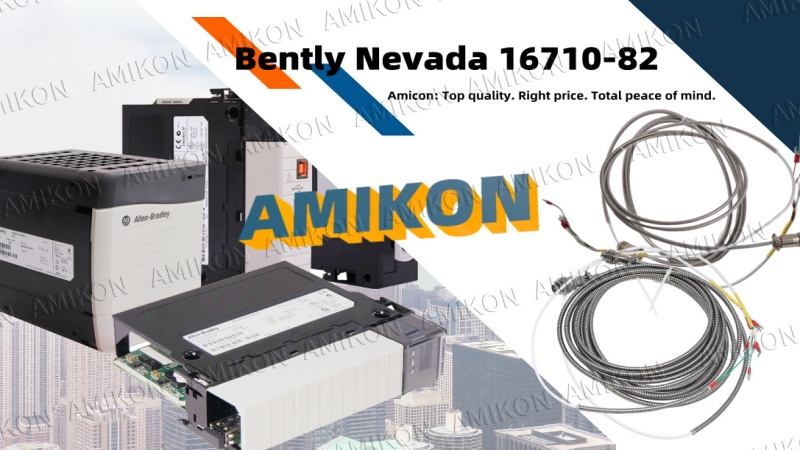
If you've worked in plants or refineries, you know the drill. Turbines, compressors, fans—these machines need constant monitoring. Vibration and acceleration data tell you when something's going wrong before it turns into a catastrophic failure. The problem? Most industrial sites are electrically noisy. Variable frequency drives, big motors, and all sorts of other gear create interference that can mess up ordinary cables. What you get at the other end is a signal so dirty you can barely trust it. For applications like gear mesh monitoring, where casing acceleration measurements need to be spot on, that's a real problem. Bently Nevada's 16710-82 armored cable is built to solve exactly that—making sure the signal from your 330400 or 330425 accelerometer gets to the data collector clean and intact.
Three-Core Shielding That Actually Does Its Job
The 16710-82 uses a three-core shielded design. Each conductor is 22 AWG (0.5 mm²) tinned copper, and there's an overall shield wrapped around all three. This setup does a solid job cutting down common-mode and differential-mode noise. Keep in mind, the 330400 accelerometer puts out 100 mV/g, and the 330425 puts out 25 mV/g. Those are pretty small signals—it doesn't take much interference to drown them out. This cable keeps the signal clean over runs up to 99 feet (30 meters). And it's not a pain to work with either. It bends well enough for conduit pulls and tray routing, so your installers won't be cursing under their breath.
Armor That Takes the Punishment
Cable trays, conduit bends, junction boxes—these are rough neighborhoods for ordinary cables. People step on them. Tools get dropped. Sometimes rodents chew through them. The 16710-82 has a helical metal armor layer that handles compression, tension, and shear way better than non-armored cables. If someone steps on it or gives it a good yank, the conductors inside stay intact. And in outdoor or cable trench installations, that armor gives you some peace of mind against four-legged pests. Bently Nevada didn't turn it into a rigid metal pipe, though. It's still flexible enough to route through tight spots without putting stress on the connector or pulling the sensor base loose.
Lengths from 3 to 99 Feet, Plus the Right Connectors
One end of the cable has a three-socket plug that mates directly with 330400 or 330425 accelerometers. The other end has terminal lugs for hooking up to junction boxes or data acquisition gear. You can order it in any length from 3 feet (0.9 m) to 99 feet (30 m), in 1-foot increments. Standard stocked lengths include 6, 8, 10, 12, 15, 17, 20, 25, 30, 33, 50, and 99 feet. When you order, the "AA" in the part number is where the length code goes. For example, 1.5 means 15 feet (4.57 m), and 2.0 means 20 feet (6.10 m). Need a non-standard length? No problem—you can order it, though there's a little extra cost. Bently Nevada also offers an installation manual (part number 133080-01) that walks you through proper cable routing and termination. It's worth a read—bad installation can ruin even the best cable.
Quick Look at the Specs
Just to put it all in one place: the 16710-82 has three 22 AWG (0.5 mm²) tinned copper conductors, overall shielding, and helical metal armor. One end is a three-socket plug, the other end is terminal lugs. Minimum length is 3.0 feet (0.9 m), maximum is 99 feet (30 m). It's designed for Bently Nevada 330400 and 330425 accelerometers. Good EMI rejection, good mechanical toughness, and it holds up fine in typical industrial environments. One thing to watch out for: when you pick a length, don't just guess. Measure your actual routing path and avoid leaving big coils of slack. Extra cable coiled up can cause signal reflections or pick up coupling interference. If you need a run longer than 99 feet, talk to a qualified engineer to see if signal attenuation is going to be an issue.
Bottom Line: Don't Overlook the Cable
A lot of people focus on the sensor and the data collector and forget about the cable in between. But your measurement chain is only as good as its weakest link. The Bently Nevada 16710-82 gives you shielding, armor, good connectors, and flexible length options—everything you need to get a clean, reliable acceleration signal from point A to point B. Whether you're building out a new system or upgrading an existing one, it's worth a serious look. And one last thing: install it right. Flat mounting surface, proper torque on the sensor, no sharp bends or side loads on the cable. That's how you get the performance this cable was designed to deliver.
Need help picking the right configuration, getting a quote, or tracking down the technical manual? Reach out to:
Whatsapp: +86 18020776782
|
A03B-0819-C155 A03B0819C155 |
EATON CEAG 3-PM-I0-INV |
|
UDK5214NW 5 |
GEC Alsthom A96LC |
|
Phytec 2150.5 |
Typ 700 220-230V 700-770W |
|
108378 |
VSF15-05 |
|
TXM1.8X TXM18X 8-I/O |
SMC ISE40-T1-22 R07-100-RNLA |
|
RRS 10 |
C500-ID219 3G2A5-ID219 |
|
General Electric RR7 |
HC-KFS43B AC |
|
EDA PCBA-05431 . PCBD05431 |
CP6-EM 201817630 CP6EM |
|
1305041H91 |
AD240-24 |
|
C40P-EDR-A C40PEDRA |
GMI 65210 GMI |
|
UPS503-1PN UPS5031PN |
mc-5155MS 100 |
|
242100.000 . 1.2 SW-Ver. 02.00 |
OMRON E3S-DS10E4 E3SDS10E4 E3S |
|
FYS-40011DUHR-12 F |
507-930013111 |
|
CV-M530 |
V24B24C200BL |
|
SPS-600 CTI600 TDK |
V24B12C200BL |
|
KV-40DT |
7145.20.3111 |
Previous :
Bently Nevada 330130-085-11-05: Long-Distance Damage-Resistant Eddy Current Sensor Extension Cables Designed for Core Industrial EquipmentNext :
Bently Nevada 21000-28-05-15-050-03-02 Proximity Probe Housing Assembly: Explosion-proof and Compliant, Empowering Precise Monitoring of Industrial EquipmentSupplyed
525011

parts to
23253

customers in
148

countries



Disclaimer:
Amikon sells new and surplus products and develops channels for purchasing such products. This website has not been approved or recognized by any of the listed manufacturers or trademarks.
Amikon is not an authorized distributor, dealer, or representative of the products displayed on this website. All product names, trademarks, brands, and logos used on this website are the property of their respective owners. The description, explanation, or sale of products with these names, trademarks, brands, and logos is for identification purposes only and is not intended to indicate any association with or authorization from any rights holder.
Powered by amikonplc.com