Relay: The Silent Commander of Industrial Control
What is a relay and why has it survived for over 100 years?
A relay is an electrically operated switch that uses a small control current to open or close a much larger load current. Its century-long dominance comes from three irreplaceable virtues: simplicity, isolation, and reliability. In an age of semiconductors, no electronic component can match a relay's ability to physically separate control and power circuits while withstanding surges, shorts, and extreme environments.
Basic Construction
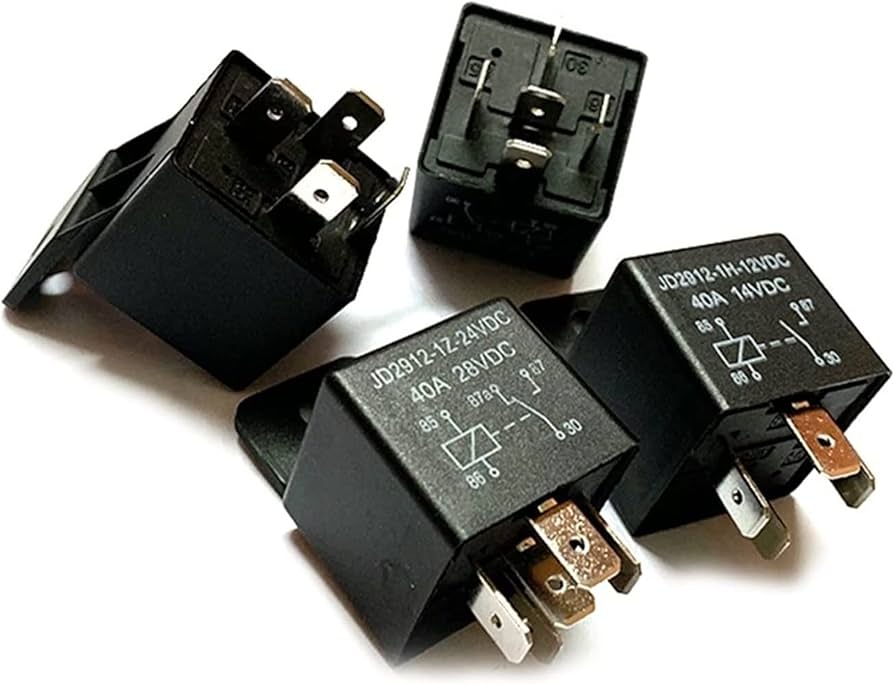
A traditional electromechanical relay consists of four essential elements:Electromagnet (Coil): A wire wound around a magnetic core. When energized, it generates a magnetic field.
Armature: A movable iron piece, hinged or pivoted, attracted by the magnetic field.
Spring: Returns the armature to its resting position when the coil is de-energized.
Contacts: Conductive elements that make or break the load circuit.
Normally Open (NO): Contacts open when coil off, close when coil energized.
Normally Closed (NC): Contacts closed when coil off, open when coil energized.
Common (C): The moving contact shared between NO and NC.
How It Works
Step 1: A small control voltage (e.g., 24 VDC) is applied to the coil.
Step 2: Current flows, magnetizing the core.
Step 3: Magnetic force overcomes spring tension, pulling the armature.
Step 4: Armature movement transfers the common contact from NC to NO (or vice versa).
Step 5: Load circuit is opened or closed.
Step 6: When control signal removed, spring returns armature to original state.
Core Functions
The primary function of a relay is signal amplification. Milliwatt-level control signals—originating from PLCs, microcontrollers, or pushbuttons—can switch kilowatt-level loads. A single PLC digital output with a mere 0.5A drive capability can energize a relay coil, whose contacts then directly control a motor drawing 10A, 20A, or even hundreds of amperes.
The second core function is galvanic isolation. The air gap between coil and contacts provides typical withstand voltages of 1.5kV to 4kV. Surges, spikes, and ground loops cannot cross this physical barrier. More critically, this isolation protects low-voltage control circuits from high-voltage hazards, making relays mandatory in safety interlocks, medical devices, and explosive atmospheres. No semiconductor device can match the dielectric strength and the completely severed physical disconnection that relay contacts provide.
The third core function is logic implementation. Before the era of PLCs, entire factory control systems were built exclusively from relays—and a significant portion remain in operation today. By wiring multiple relays together, engineers implemented combinational logic such as AND, OR, and NOT functions, as well as sequential logic including self-holding circuits, time delays, and counting.
The fourth core function is signal routing and multiplexing. Relays are not confined to switching power; they also switch audio, video, radio frequency, thermocouple, and instrumentation signals. Specialized reed relays, with their hermetically sealed contacts and extremely low and stable contact resistance, excel in precision measurement applications.
The importance of relays is first rooted in the principle that isolation is the first law of safety. In industrial control, safety equals separation. When safety circuits demand forcibly guided contacts, when they require mechanical interlocking, only electromechanical relays can comply. Certified safety relays feature mirror contacts—mechanically linked normally open and normally closed pairs; forced guidance ensuring that even if contacts weld, they cannot all close simultaneously; redundant paths; and self-diagnostic capabilities. In life-critical applications such as emergency stop circuits, light curtains, and two-hand controls, the relay stands as the final physical defense. Algorithms can err. Code can crash. But a pair of mechanically interlocked contacts will never deceive you.
Finally,the relay sits at the terminus of the control path. Before it: years of research and development, microprocessors containing millions of transistors, gigabytes of software code, artificial intelligence algorithms in the cloud. After it: power. Motors that move tons of material. Heaters that melt steel. Solenoids that halt trains.
The relay is the interface between the world of logic and the world of energy. It possesses no consciousness, no algorithm, no IP address. But when the PLC commands "start," when the safety circuit demands "stop," when the thermostat calls for "heat"—the relay obeys. Instantly. Decisively. Isolated.
In an industry perpetually chasing the new, the relay is the old soldier who never retires. It is not glamorous. It is not intelligent. But industrial control without relays is impossible.
One hundred years from now, when current flows through a coil, when a magnetic field pulls an armature, when a spring returns it, when a pair of silver contacts closes—the device that emits that familiar click will still be a relay.
Tags :
New Blog
Supplyed
525011

parts to
23253

customers in
148

countries



Disclaimer:
Amikon sells new and surplus products and develops channels for purchasing such products. This website has not been approved or recognized by any of the listed manufacturers or trademarks.
Amikon is not an authorized distributor, dealer, or representative of the products displayed on this website. All product names, trademarks, brands, and logos used on this website are the property of their respective owners. The description, explanation, or sale of products with these names, trademarks, brands, and logos is for identification purposes only and is not intended to indicate any association with or authorization from any rights holder.
Powered by amikonplc.com