When it comes to industrial automation equipment, what used to be everyone's biggest concern? Efficiency? Stability? Durability?
But now, things have changed. Whether you're a factory owner, purchasing manager, or production line engineer, everyone has a new "ledger" to keep—how much carbon does this machine emit from production to disposal?
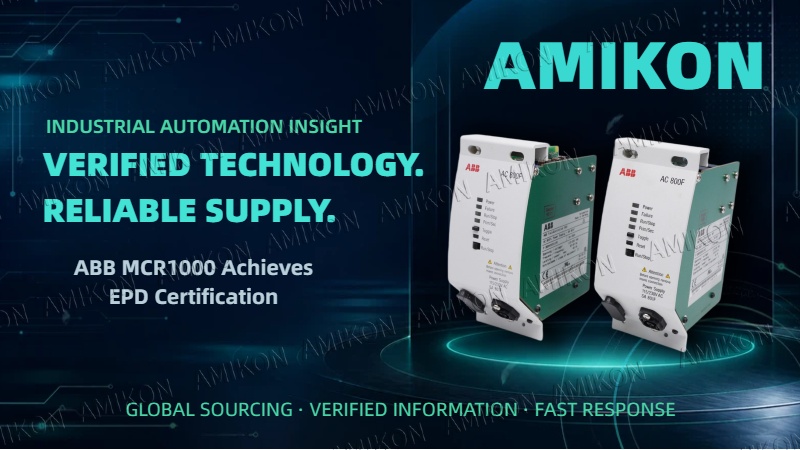
To deliver this green answer, industry giant ABB recently made a significant move. Their flagship product—the MCR1000 high-power rectifier—has secured two major international certifications: Life Cycle Assessment (LCA) and Environmental Product Declaration (EPD).
This makes it the first "top student" in ABB's global high-power rectifier family to achieve both certifications. This equipment benefits from the technical expertise of a Swiss team, continuous optimization by a Chinese team, and final manufacturing at ABB's Shanghai factory. Its certification provides a timely boost to low-carbon procurement in the industrial sector.
Why is EPD certification so essential when buying equipment now?
In international trade, simply claiming to be "green and environmentally friendly" is no longer enough. Especially after the EU's Carbon Border Adjustment Mechanism (CBAM) was officially implemented, companies purchasing bulk materials or heavy industrial equipment must provide concrete carbon emission data.
But for buyers, the market is flooded with various "green labels," so how can they avoid "green drift" (false advertising)?
This is where the EPD (Environmental Product Declaration) comes in. It's not just the manufacturer's self-promotion; it's based on rigorous scientific assessment and reviewed and stamped by an independent third-party organization.
Simply put, a reliable EPD will thoroughly expose the product's carbon footprint throughout its entire lifecycle:
Mining Phase: How were the raw materials extracted?
Manufacturing Phase: How much electricity and carbon were emitted during the factory's production of this machine?
Transportation Phase: How much exhaust fumes were emitted during the journey from the Shanghai factory to the customer's site?
Usage Period: Running continuously in the factory every day, what is its energy consumption performance?
Retirement Period: After it's no longer needed, is it easy to dismantle and recycle?
With this clear accounting, the purchasing and engineering teams no longer need to believe those empty advertising slogans; everything is based on objective, comparable data.
Unveiling the "Green Advantage" of the MCR1000
The MCR1000 is not an ordinary electronic product. It is specifically used in energy-intensive industries such as aluminum electrolysis, steelmaking, chemicals, non-ferrous metals, and green hydrogen. These environments are harsh, and the requirements for equipment are extremely high.
Through this life cycle assessment (using the industry-leading SimaPro software and the Ecoinvent database), ABB proved one thing: true environmental friendliness in industrial equipment is not about cutting corners, but about a long lifespan, extremely high energy efficiency, and a recyclable green design.
This also finally allows the technical engineering team and the purchasing ESG team to sit down at the same table for meetings. Engineers prioritize performance and reliability, while procurement and environmental teams can directly utilize existing data for carbon inventory and compliance reporting, finally putting everyone on the same page.
Environmental protection is just the beginning; more big moves are yet to come
The MCR1000 certification is merely the starting point for ABB's green transformation.
Ralph Burgener, a senior executive at ABB's Process Industries division, stated frankly that in today's industrial investment environment, where sustainable development is increasingly valued, this dual certification is a significant milestone. Qin Ming, head of ABB China's business, also revealed that leveraging the successful experience of the MCR1000, they will next extend this "green check-up" system to more high-power rectifier series manufactured in China, such as the HCR6000 and LCR900.
For domestic and international buyers and equipment distributors, this means that future rectifier purchases will not only have guaranteed technical parameters but also a clear and transparent environmental carbon accounting record.
Procurement and Engineers: How to copy this approach in the next tender?
If you're preparing to add new equipment to your factory or writing tender technical specifications, consider using this EPD guide as a reference:
Clarify the Scope: Don't just look at the overall data; clarify with the supplier whether their calculations apply to the specific model you're purchasing.
Compete with Others: When comparing different products, ensure that everyone's "calculation rules" and "boundaries" are the same. Don't compare an apple to a large truck.
Take a Two-Pronged Approach: While environmental data is important, electrical performance, cooling efficiency, availability of spare parts, and after-sales service remain crucial. Treat EPD as a bonus, not the sole deciding factor.
In summary, the MCR1000 obtaining EPD certification signifies that environmental advocacy in the industrial automation field is moving beyond empty promises and into a transparent era focused on solid data.
Contact Information:
Manager: Jim Pei
Email: sales6@amikon.cn
Whatsapp: +8618020776782
Recommended Model
|
88UM01A |
81EU01E-E |
|
GJR2393800R0100 |
GJV3074340R1 |
|
88QB03B-E |
07EB60R1 |
|
TBI-24/0C |
88VP02B-E9102 |
|
HESG447024R1 |
HESG447440R0001 |
|
177230-01-01-CN |
FS-PDC-IOX05-1 |
|
190501-00-00-CN |
FS-PDC-IOS05 |
|
190501-04-00-CN |
FS-PDC-IOR05 |
|
6SL3350-6TK00-0EA0 |
FC-PDB-IO05 |
|
6SE7038-6GL84-1BG2 |
FS-PDB-CPX05 |
|
6SE7090-0XX84-0AB0 |
FC-PDB-0824 |
|
3500/22M |
FS-CPCHAS-0001 |
|
SST-PB3-REM |
FC-PSU-240516 |
|
HIMA F8621A |
FC-QPP-0002 |
|
1794-IR8 |
FC-BKM-0001 |
|
1756-TBCH |
FE-USI-0002 |
|
TSXPSY2600 |
FC-DCOM-232/485 |
|
6SY7000-0AD33 |
70BA01c-S |
|
HESG447260R2 |
HESG332204R0001 |
|
HE667102-318/ |
70PR05b-ES |
New Blog
Supplyed
525011

parts to
23253

customers in
148

countries



Disclaimer:
Amikon sells new and surplus products and develops channels for purchasing such products. This website has not been approved or recognized by any of the listed manufacturers or trademarks.
Amikon is not an authorized distributor, dealer, or representative of the products displayed on this website. All product names, trademarks, brands, and logos used on this website are the property of their respective owners. The description, explanation, or sale of products with these names, trademarks, brands, and logos is for identification purposes only and is not intended to indicate any association with or authorization from any rights holder.
Powered by amikonplc.com