As the AI wave sweeps across industries, many companies are caught in a dilemma of "heavy on technology, light on implementation"—deploying AI systems and collecting massive amounts of data, yet struggling to translate them into actual productivity. This is especially true in energy and industrial scenarios, where aging equipment, complex production lines, and stringent safety requirements repeatedly hinder intelligent upgrades. At this juncture, Schneider Electric's "Win-Win Program," launched in conjunction with the International Economic and Technological Cooperation Center of the Ministry of Industry and Information Technology, is using an ecosystem collaboration model to move AI from conceptual narrative to industrial practice, providing a feasible and replicable intelligent upgrade solution.
Breaking the Implementation Bottleneck: The Ecosystem Co-creation Logic of the "Win-Win Program"
Unlike traditional innovation incubation models, the core of the "Win-Win Program" is building a collaborative mechanism between large enterprises and SMEs. Since its launch in 2020, the program has iterated into a complete closed loop of accelerator camps, growth camps, and AI+ exploration camps, attracting over 1,300 SMEs and incubating more than 40 joint innovation achievements, covering multiple industries such as power grids, chemicals, and metallurgy. Schneider Electric provides real-world scenarios, technology platforms, and industry resources, while its innovation team contributes algorithmic capabilities and scenario understanding. Together, they address the industry pain points of "disconnect between technology and engineering, and gap between innovation and implementation," enabling AI to be truly embedded in the industry's operational system.
Energy Sector: AI Empowers Grid Safety and Efficient Operation
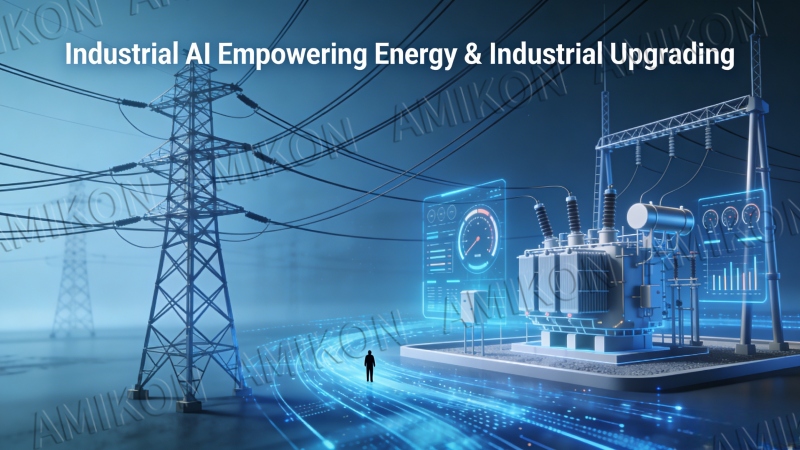
With the high proportion of renewable energy integration, traditional power distribution systems are struggling to cope with complex operating conditions. The "Innovation and Success Plan" focuses on pain points in energy scenarios, incubating several practical solutions. Digital twin substations achieve equipment status visualization through 3D mapping, reducing maintenance response time by 30%, becoming a benchmark for large-scale applications in the power distribution field; the high-speed self-healing system for distribution network faults integrates 5G and differential technology to achieve millisecond-level fault location and isolation, and has been implemented in Zhejiang and other regions, receiving high-reliability upgrade benchmark recognition, strengthening the safety defenses of the renewable energy grid; the campus power intelligent management system uses AI current fingerprint algorithms to solve the problem of monitoring electricity consumption in aging facilities, providing a reference for refined energy use in public scenarios.
Industrial Scenarios: Low-Disruption Upgrades for Cost Reduction and Efficiency Improvement
The core demand in industrial settings is "uninterrupted production," and the "Winning Plan" consistently adheres to the principle of "gradual upgrades." The Industrial Zero-Trust Security Solution is the first to introduce the zero-trust concept into industrial control systems, achieving tiered protection of critical assets without affecting production. It has been implemented in chemical and metallurgical enterprises across multiple regions and has even gone global. The predictive maintenance platform for transmission systems uses frequency converters as data entry points, employing AI algorithms to proactively identify equipment failure trends. Pilot data shows it can improve equipment utilization by 17% and reduce maintenance costs by 25%, shifting from reactive maintenance to proactive intervention.
Key Insight: The Value of Industrial AI Lies in "Embedding" Rather Than "Addition"
Schneider Electric's "Winning Plan" confirms a core logic: the value of industrial AI lies not in the sophistication of its models, but in its ability to deeply integrate with existing systems and solve real-world pain points. Compared to single-point technological breakthroughs, this plan prioritizes engineering credibility and business sustainability, transforming AI from an "add-on" into a "structural capability" for industrial operations through institutional innovation. This also reveals the competitive trend in industrial AI—the future competition will not be about model computing power, but about system embedding capabilities and ecosystem collaboration capabilities.
Conclusion
As industrial AI enters deeper waters, Schneider Electric's "Winning Initiative" provides a pragmatic upgrade path: breaking down innovation barriers through ecosystem collaboration and solving implementation challenges through scenario-based approaches, allowing AI technology to truly generate value in energy and industrial scenarios. For SMEs, joining such a collaborative innovation platform allows them to leverage the resources of large enterprises to solve technology implementation problems and also tap into scenario value through their own innovative vitality. In the wave of industrial intelligent upgrading, only by adhering to the principles of "co-creation, pragmatism, and feasibility" can AI truly become the core driving force for high-quality industrial development.
Recommended Products
|
MCR-SL-U-I-0 2813512 MCRSLUI0 |
PTP35-A2A13P1PH4A |
EDS334850001000F1 |
|
SIEMENS 6FX1142-2BA02 |
HITACHI 33016136-5 |
200/3E-20A0 |
|
PW12CC3MR K-PW12C-N-MR-50-N-6-N-5-N |
NUMATICS 34203626 |
M511002001R1 |
|
HG27 RS232 |
WA/20mm 050310129 090610052 |
IDML4004 |
|
GL10-IR/32/40a/98a |
DPA-63-10 |
VADM200P MS0EB-3-24V |
|
WVE 32-25 |
H920 |
FESTO LRS-D-I-MINI 194613 |
|
00F5060-5A11 |
PN3093 |
1020 500 03S12-03 317 750-2R |
|
CL100 050192-104 |
K2001000100M |
SICK WS12L-2D431 |
|
00.F5.060-5A11 |
PCD3W800 |
SICK 1042050 WTB4S-3P2234 |
|
BOSCH 0 811 405 007 0811405007 1 818 310 002-4V0 |
BONFIGLIOLI VF 49/F2-10 P 80 B14 B3 |
NTMMS2M122KTT12SVAR |
|
1-537-10-V0-QV |
UB40012GME5V1 |
105008-19 |
|
BIK151 239646 6051-042.239646 |
DFR713P |
CAN/M3/FLASH/80515/V1.23 |
|
6180-AEGBFEZGBCZ 61-0548-13 61054812 |
PT/EL-DR-5BAR-S1-HA-TH-SS |
BLS3-4 BLS3 960602 |
|
6ES5605-8RB12 |
UDS3/200MB/4/20/G1/4E/F 0423-224 |
2000018 KA12A10A0 11180747 |
|
CA-CNX10U |
VRDM397/50LWB |
MS2712R |
|
P501000AC06 SI322AX1 |
MPPES31410420 |
20000182 |
|
DS334850001000F1 |
6GK57980SN000EA0 |
SFET-F500-L-W18-B-K1 |
|
200/3E-20A0 |
WTT280L-2P2531 6048061 |
TZ2LE024PGVAB 074308 |
|
M511002001R1 |
MSQB20H2 |
6ES5941-7UA12 |
|
IDML4004 |
MSQB30H3 |
MDX60A0110503400 |
Manager: Leonia Email:sales11@amikon.cn Whatsapp: +8618030175807
New Blog
Supplyed
525011

parts to
23253

customers in
148

countries



Disclaimer:
Amikon sells new and surplus products and develops channels for purchasing such products. This website has not been approved or recognized by any of the listed manufacturers or trademarks.
Amikon is not an authorized distributor, dealer, or representative of the products displayed on this website. All product names, trademarks, brands, and logos used on this website are the property of their respective owners. The description, explanation, or sale of products with these names, trademarks, brands, and logos is for identification purposes only and is not intended to indicate any association with or authorization from any rights holder.
Powered by amikonplc.com